Estimated disposable menstrual products the average person uses across their reproductive lifetime — most ending in landfill, many containing synthetic materials in contact with vaginal mucosa.
Environmental audit data; Women’s Environmental Network, 2021
The vaginal microbiome is a dynamic, living ecosystem — predominantly composed of Lactobacillus species — that maintains a protective acidic environment (pH 3.8–4.5) and actively defends against bacterial and fungal infection. Menstruation temporarily disrupts this environment: menstrual blood is pH 7.4, temporarily raising vaginal pH and creating a window of relative vulnerability.
What you use to manage that blood matters. The material, the absorbency, the breathability, and the chemical composition of your menstrual product all interact with this ecosystem during the hours it is most disrupted.
The most comprehensive scientific review of menstrual cup safety was published in The Lancet Public Health in 2019. Van Eijk and colleagues conducted a systematic review and meta-analysis of 43 studies, covering over 3,300 participants, examining cup leakage, acceptability, safety, and microbiological impact.[1]
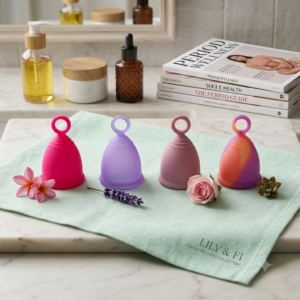
The findings were clear: menstrual cups showed similar or lower rates of leakage compared to disposable products. Crucially, the review found no evidence of adverse effects on the vaginal microbiota when cups were used and cleaned correctly. Medical-grade silicone — the material used in Lily & Fi cups — is non-porous, does not harbour bacteria between uses, and does not interact with vaginal tissue in the way that cotton fibres or synthetic polymers can.
Conventional disposable pads and tampons may contain residual pesticides from non-organic cotton cultivation, synthetic fragrances — which are associated with vulvovaginal irritation — and dioxin traces from chlorine bleaching processes. Regulatory bodies generally classify individual exposure levels as within acceptable limits; however, “acceptable limits” are calculated for adult reference bodies that do not reflect the specific absorptive properties of vaginal mucosa, or lifetime cumulative exposure across 40 years of menstruation.
Research from 2020–2023 has increasingly examined this question. While consensus has not yet reached the level of definitive causal harm, the precautionary principle supports reducing unnecessary chemical exposure to one of the body’s most permeable tissue surfaces — particularly when equally effective, chemical-light alternatives exist.
🌴 Why This Pillar Is Different in the Caribbean
Ambient temperatures of 26–34°C, high relative humidity, and the physical demands of active Caribbean life create conditions where moisture retention against the skin accelerates bacterial and fungal growth. Disposable pads, which trap heat and moisture against vulvar tissue, may be less well-suited to this climate than is typically acknowledged. Medical-grade silicone cups — which do not absorb moisture, do not create external contact with the vulva, and require no adhesives or synthetic materials — and moisture-wicking period underwear are physiologically better matched to a tropical environment. This is science applied to geography.